TOY COMPUTERS
A playful history of the machines that taught a generation to think in binary — from tin adding machines and relay brains to the talking toys of the microprocessor age.
Before the computer was an appliance, it was a mystery: room-sized, air-conditioned, attended by a priesthood in white coats. The toy computer industry of 1950–1980 did something remarkable — it shrank the mystery to kit form and sold it by mail order. For the price of a bicycle, a kid could own a machine that added, remembered, and — if wired with sufficient patience — refused to lose at tic-tac-toe.
Tic-tac-toe deserves a word here. It became the “hello, world” of toy computing: the standard demonstration that a machine was really thinking and not just blinking. Nearly every machine in this exhibit played it, or claimed to. The claims were not always strictly true, which is part of the charm.
And the toy computer is older than the electronic computer. Before the machines below, there were tin toy adding machines — one Pittsburgh model cheerfully summed numbers up to 9,999 — clockwork calculators for the nursery. The instinct to shrink the calculating machine to plaything size predates the transistor by decades.
1950 — Simon, the “mechanical brain”
Edmund C. Berkeley · plans published, ~$300 in parts to build
Edmund Berkeley — actuary, computer pioneer, and founder of the journal Computers and Automation — believed the public should meet computers up close rather than admire them from behind glass. His Simon, described in a famous 1950 fact sheet as the “smallest complete mechanical brain in existence,” was a relay-based machine you could build from published plans. It added numbers, made choices, and printed its answers. Berkeley’s Berkeley Enterprises would go on to seed the entire toy-computer industry.
→ See also our archived Edmund C. Berkeley page and the original Simon FAQ.
1955 — GENIAC, the “electrical brain” kit
Berkeley Enterprises · Oliver Garfield · $19.95 · ~400 parts
The GENIAC — “Genius Almost-automatic Computer,” with a wink at ENIAC — was the first toy computer sold at scale. The kit held a wedge-shaped case, a console panel, and nearly four hundred parts, dominated by six perforated Masonite discs that served as rotary switches. You programmed it by pushing brass jumpers into the backs of the discs and wiring them to flashlight bulbs; a single flashlight battery powered the whole affair.
The GENIAC had no memory and no active components — no relays, no tubes, no transistors. Its outputs depended entirely on inputs you set by hand, which meant all sequencing was performed by the operator, sometimes following elaborate printed choreography (“turn this wheel left if this light lights…”). Wired with sufficient devotion, it played an unbeatable game of tic-tac-toe. Berkeley’s follow-ups, the Brainiac (1958) and Tyniac, refined the formula. Oliver Garfield kept selling GENIAC-style kits into the 1960s.
1960 — Think-a-Tron, the machine that “thought”
Hasbro · slogan: “It thinks! It answers! It remembers!”
Hasbro’s Think-a-Tron looked like a miniature Eisenhower-era mainframe and promised accordingly. In truth it did roughly one of the three advertised things — but what a thing. Players fed it punch cards printed with trivia questions; inside, a disk punched with holes spun between a light bulb and the display lenses while a clever linkage read a notch in the card’s edge and stopped the wheel on the correct answer’s letter. It was a mechanical illusion of intelligence, and an effective one: the machine evoked the room-filling computers of the day in a plastic cabinet on a living-room rug. The marketing oversold it. The kids didn’t care.
1960 — Heathkit EC-1, the analog detour
Heathkit · $400 in kit form · 9 vacuum-tube op-amps
Every other machine in this exhibit is digital. The EC-1 respectfully declines. Heathkit’s Educational Analog Computer represented numbers as voltages, not bits: nine vacuum-tube operational amplifiers, patch cords, potentiometers, and a built-in meter that read the answer directly. Assemble it yourself in 25 to 30 hours (the famous Heathkit manuals promised they wouldn’t let you fail), then solve falling-body problems, spring-mass systems, and simultaneous equations — the actual mathematics of rockets and aircraft, on a box the size of a microwave oven. It is the only computer here that could not play tic-tac-toe, and the only one that could model a projectile in a viscous medium. Trade-offs.
1961 — Minivac 601, the $85 digital trainer
Scientific Development Corporation · $85 · relay logic
The Minivac 601 was the serious student’s machine: an electromechanical digital computer kit in a blue wooden case, using DPDT relays as logic switches and storage, with a six-bit binary input/output array of slide switches, pushbuttons, and indicator lamps. A 16-position motorized rotary dial could enter decimal numbers or serve as a clock. Jumper wires with tapered pins patched it all together — just barely enough computer, as the manual cheerfully admitted, to play a winning game of tic-tac-toe or simulate an elevator controller.
The Minivac carries a genuine mystery: it is widely associated with Claude Shannon, the father of information theory, who built electromechanical games and collaborated with Berkeley on earlier kits — yet the IEEE History Center could find no paper trail tying Shannon to the 601’s design. An “advanced and improved” Minivac 6010 followed in 1962 in a gray metal case, aimed at the corporate training market at a considerably higher price.
1963 — Digi-Comp I, the $5 mechanical computer
E.S.R., Inc. · $4.99 · all plastic, no electricity
The Digi-Comp I is the most beloved machine in this exhibit and arguably the purest: a functioning three-bit digital computer made entirely of polystyrene and rubber bands. Three mechanical flip-flops, programmed by pushing or blocking thin vertical wires with cylindrical pegs, were “clocked” by sliding a lever back and forth. Different peg arrangements yielded different Boolean operations; the 3-bit readout could add, subtract, shift bits, and — the showpiece — play Nim with machine-enforced rules. Promotional copy called it an “actual working digital computer.” Pedants note it is more precisely a finite-state machine, which is exactly the concept it was teaching. It has been called the first home computer, and nobody has successfully argued the title away from it. A cardboard reproduction, the Digi-Comp I version 2.0, is still sold today.
E.S.R. kept the mechanical-computing dream alive with the Digi-Comp II (a two-level inclined plane where rolling marbles flipped plastic cams — a visible calculator rather than a programmable machine), Dr. Nim (a plastic Nim-playing computer), and the Think-a-Dot (invented by Joseph Weisbecker): eight colored disks and a ball bearing demonstrating automata theory across 256 internal states.
1970s — Science Fair kits
Radio Shack · various

By the 1970s the electronics hobbyist movement had its own retail channel, and Radio Shack’s Science Fair line put microcomputer trainers into strip malls. These were less “toy” than “trainer” — hexadecimal keypads, LED readouts, real (if tiny) processors — but they served the same purpose the GENIAC had served twenty years earlier: demystification by ownership. A generation that soldered its first kit in a Science Fair box went on to buy Altairs.
1970s — The Tinkertoy computer
Danny Hillis & Brian Silverman, MIT · 10,000 parts · never loses
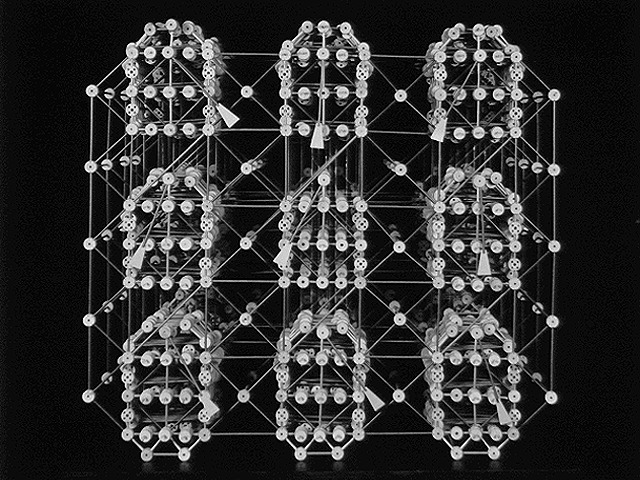
The logical endpoint of the entire genre was built not by a company but by MIT students proving a point: computation is not limited to electronics. Danny Hillis and Brian Silverman assembled some 500 boxes of Tinkertoys — 10,000 wooden parts, fishing line, sinkers, and brass pins — into a machine that played perfect tic-tac-toe. Nine flags on the front showed the board; the human moved a flag, and mechanical linkages answered almost instantly. It never lost, though in practice it played unreliably, because the fishing line tended to loosen and slip. Taller than a person and made of toys, it now sits in the Computer History Museum — the toy computer genre’s graduation portrait.
1976–1979 — The microprocessor generation
Texas Instruments · Milton Bradley · Parker Brothers · Mego
The microprocessor did to toy computers what the transistor had done to radios: suddenly the thinking could fit inside the toy instead of being simulated around it. The results defined a thousand childhoods.
Little Professor (1976, Texas Instruments). A calculator turned backwards: instead of giving answers, it asked questions — “7 × 8 = ?” — and graded your arithmetic. The dry run for everything TI did next.
Simon (1978, Milton Bradley). Designed by Ralph Baer and Howard Morrison: four colored panels, four tones, and a microprocessor with a grudge. The game — repeat the growing sequence — was trivially simple and utterly hypnotic, and the hardware (a saucer that lit up and sang) made the computer feel like a creature.
Merlin (1978, Parker Brothers). Inventor Bob Doyle’s red paddle packed six games — including tic-tac-toe, naturally, plus blackjack and “music machine” — into 11 buttons and a grid of lights. The first handheld that felt like a computer rather than a game.
2-XL (1978, Mego). A wise-cracking plastic robot whose brain was an 8-track tape. Follow the tape’s quiz tracks, press the right button, and 2-XL told you whether you were right — with personality. The punch-card spirit of the Think-a-Tron, upgraded to magnetic tape and jokes.
Speak & Spell (1978, Texas Instruments). The crown jewel. A spelling tutor built around TI’s TMS1000 microprocessor and a genuine engineering marvel: the first mass-produced product with speech synthesis, using linear predictive coding to squeeze a voice out of chips that couldn’t have stored recordings. It spoke words aloud, waited for you to spell them on its keyboard, and accepted vocabulary cartridges through the battery compartment — game cartridges before game cartridges were a thing. Named an IEEE Milestone in 2009. Nothing in this exhibit announced the future quite so clearly.
Big Trak (1979, Milton Bradley). A six-wheeled programmable tank: punch in a sequence of moves on its membrane keypad — forward 3, turn 30 degrees, fire the photon cannon — and it executed your program across the living-room carpet. For many kids, their first program wasn’t on a screen. It was a tank.
Timeline
| Year | Machine | Maker | Price then |
|---|---|---|---|
| 1950 | Simon | Edmund Berkeley (plans) | ~$300 in parts |
| 1955 | GENIAC | Berkeley / Oliver Garfield | $19.95 |
| 1958 | Brainiac | Berkeley Enterprises | kit |
| 1960 | Think-a-Tron | Hasbro | toy |
| 1960 | Heathkit EC-1 (analog) | Heathkit | $400 (kit) |
| 1961 | Minivac 601 | Scientific Development Corp. | $85 |
| 1962 | Minivac 6010 | Scientific Development Corp. | corporate market |
| 1963 | Digi-Comp I | E.S.R. | $4.99 |
| 1960s | Digi-Comp II, Dr. Nim, Think-a-Dot | E.S.R. | various |
| 1970s | Science Fair kits | Radio Shack | various |
| 1970s | Tinkertoy computer | Hillis & Silverman (MIT) | 500 boxes of Tinkertoys |
| 1976 | Little Professor | Texas Instruments | — |
| 1978 | Simon | Milton Bradley | — |
| 1978 | Merlin | Parker Brothers | — |
| 1978 | 2-XL | Mego | — |
| 1978 | Speak & Spell | Texas Instruments | — |
| 1979 | Big Trak | Milton Bradley | — |
Why toys?
Every machine here was, by the standards of its day, hopelessly underpowered — and every one of them worked. They taught binary arithmetic, Boolean logic, and the radical idea that a machine could follow rules, all to children decades before “computer literacy” was a phrase. Plenty of working engineers will tell you their career started with a GENIAC, a Digi-Comp, or a Science Fair kit. The museum considers that a fine return on $4.99.